

- Senior Software Engineer/Team Lead
- Fiddler - Texas Country Music, Bluegrass
- Sound Tinkerer (Arduino, Modular Synths, ATTINY85)
- Golang/Javascript/Typescript/Java and whatever Arduino is...C++???
- AI enthusist. Playing with various levels of building from "Vibecoding" to full spec'd out projects. ( I'm gonna say the latter is better )
I’d like to dive deeper into Haskell and Rust. Honestly, though, for what I do, the language isn’t as important as the libraries and support.
A collection of sketches for ATTiny to replace logic blocks in Lunetta-like circuits or whatever else comes to mind. They can be standalone diversions or the core for a modular synth component. Keep in mind, it’s an 8-bit microcontroller. This has been an ongoing obsession for over a decade.
I really like making things blink and go beep. There are a lot of sketches that do just that. Mostly for ATTINY85, but a few other chips are supported. It’s Arduino code, so most sketches can be refactored pretty easily.


A Golang/React-based flashcard app.
- Import format compatible with ChatGPT, so you can just ask it to create cards in markdown and import them.
- Progress stats.
- Cards are written in markdown, with code formatting supported.
- Hooks into LLM if you want more detailed answers. ( An explain function )
It’s Dockerized—so why not give it a spin? BYO API key though ( not needed, but the free one you can get for Gemini is usually enough )

Custom Cat themed piechard too!


Create cool Latex ATTINY85 pinouts from JSON files. The idea was to automate the images I use in the Arduino repo above. The tool works, but remaking all the images is still a chore I haven’t gotten around to yet.


These are more just exercises and fun experiments.

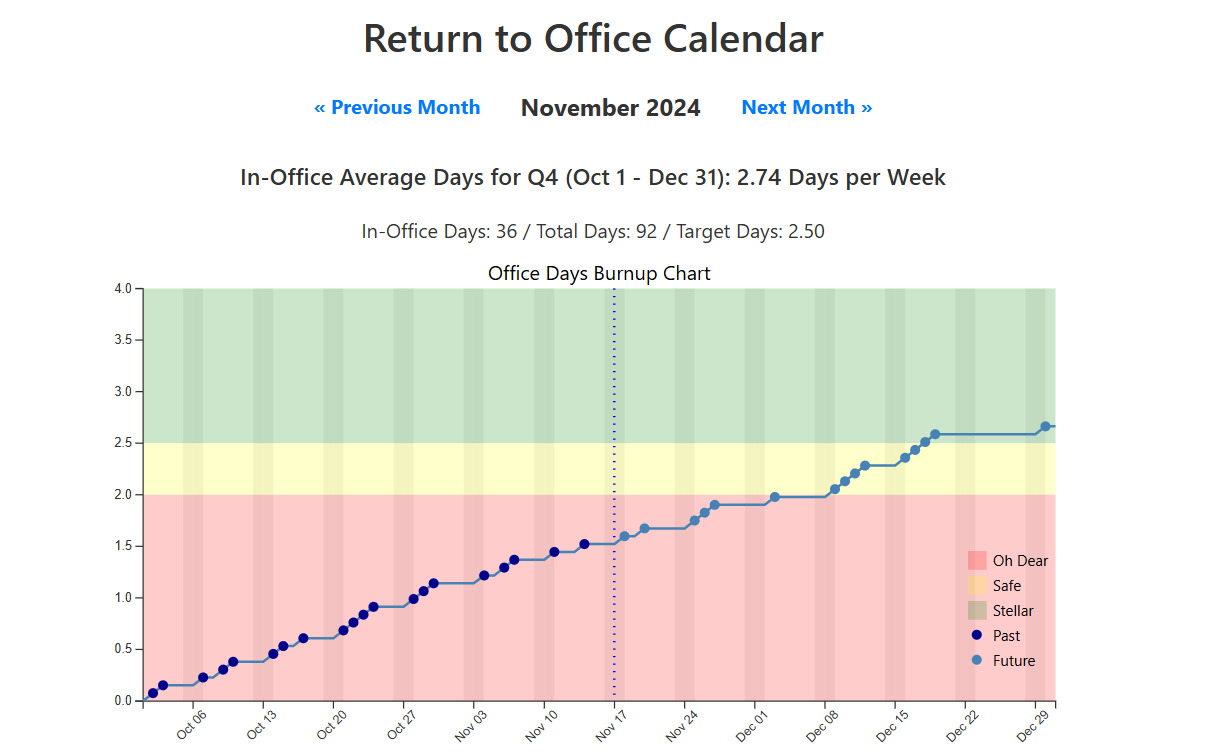
An experiment to see how little code I actually needed to write using ChatGPT. Turns out...practically none! I had it build a D3 widget interactively without manually changing any code—just a conversation (and a little copy/paste into JSFiddle).

A D3 burn-up chart for tracking RTO (Return to Office) compliance. The policy was a bit unusual — rather than requiring specific days per week, it mandated a certain number of days in office over a rolling three-month window. This chart visualized your progress toward that target.
This was my first real attempt at pure vibe coding — letting the LLM drive and just rolling with it. I wasn't thrilled with some of the architectural choices it made, but I decided to lean in and see it through. One thing that came out of it was hands-on experience with Go templates, which I hadn't used much before. Learned something in the process. That said, if I were starting over, I'd do it differently.
I would say that the chart is kinda cool though and is reusable.